All Eyes of FIFA 2026 Spectators on Trionda - How Pakistani Skills Are Kicking Their Way onto the Global Stage
Posted 4 months ago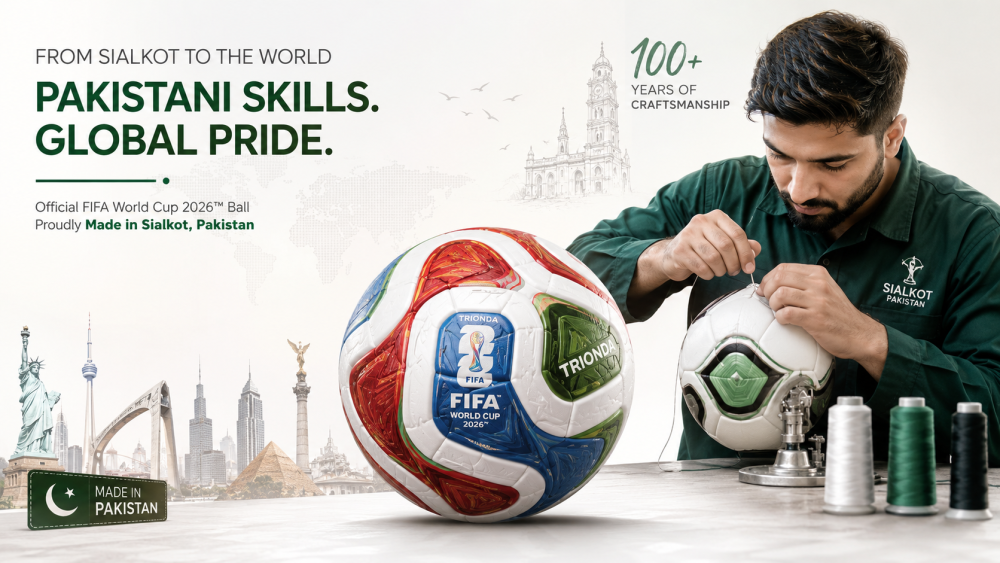
90/2026
When the first whistle blows at the FIFA World Cup 2026 in the United States, Canada, and Mexico, billions of eyes will be on the players. Yet behind every pass, tackle, and goal will be a remarkable Pakistani success story. The official FIFA World Cup 2026 match ball, Adidas Trionda, has been manufactured in Sialkot, Pakistan, a city whose craftsmanship has quietly powered the world's most beloved sport for decades.
For Pakistan, this achievement is far more than a manufacturing contract. It is a global recognition of the skill, precision, and resilience of Pakistani workers, engineers, technicians, and entrepreneurs who have transformed Sialkot into the world's football-making capital.
A Small City with a Global Footprint
Sialkot may not be among the world's largest industrial centers, but its influence on international sports is extraordinary. The city produces roughly 70 percent of the world's footballs and exports tens of millions of them annually to more than a hundred countries.
From neighborhood playgrounds in Africa and Asia to elite stadiums in Europe and the Americas, there is a strong possibility that the football being kicked was made by Pakistani hands.
This is not a recent success story. Sialkot's football-making tradition stretches back more than a century, evolving from small workshops into a globally recognized industry that combines artisanal craftsmanship with cutting-edge technology.
The Human Skill Behind Every Ball
Modern football manufacturing is often associated with automation and robotics. Yet the quality that distinguishes Sialkot remains profoundly human.
Producing a FIFA-approved football requires exceptional precision. Workers spend months mastering the craft, carefully assembling panels, inspecting seams, and ensuring each ball meets exacting international standards. Skilled stitchers can spend hours stitching a single high-quality football.
The official World Cup ball must pass rigorous tests for shape retention, weight consistency, durability, water resistance, and flight performance. Even the slightest deviation can lead to rejection. Pakistani manufacturers have repeatedly demonstrated they can meet and exceed these demanding requirements.
This ability reflects a broader truth about Pakistan's workforce: when given opportunities, training, and access to global markets, Pakistani professionals can compete with the best in the world.
From Craftsmanship to Advanced Technology
The 2026 FIFA World Cup ball is not merely a piece of sporting equipment; it is a sophisticated piece of technology.
The Adidas Trionda features advanced design elements and connected-ball technology that deliver real-time data to match officials and support modern officiating systems. The ball's aerodynamic structure and precision-engineered panels are the result of years of research and development.
What makes this particularly impressive is that such a technologically advanced product is being manufactured in Pakistan. It shows that the Pakistani industry is no longer confined to low-value manufacturing. Instead, it is increasingly participating in high-precision, technology-driven global supply chains.
A Legacy of Excellence
The partnership between Sialkot manufacturers and the FIFA World Cup is not new. Companies such as Forward Sports have previously produced official match balls for multiple World Cups, including Brazil 2014, Russia 2018, Qatar 2022, and the 2026 tournament.
Few countries can claim such a consistent presence in the world's largest sporting event.
Pakistan may not yet be competing on the football field at the World Cup, but it has become an indispensable contributor behind the scenes. Every World Cup match played with a Sialkot-made ball is a reminder that Pakistani expertise has earned a place on the global stage.
Lessons for Pakistan's Future
Sialkot's success offers valuable lessons for Pakistan's economic future.
First, skills matter. The football industry has flourished because generations of workers have developed specialized expertise that is difficult to replicate elsewhere.
Second, innovation matters. Sialkot succeeded not by competing solely on cost but by continuously improving quality, technology, and reliability.
Third, global standards matter. Pakistani manufacturers earned international trust by consistently meeting the world's highest performance standards.
These same principles can help Pakistan expand its presence across advanced manufacturing, information technology, healthcare technologies, engineering, and other knowledge-based industries.
More Than a Football
The FIFA World Cup 2026 ball is more than a sporting symbol. It embodies the aspirations and capabilities of millions of Pakistanis.
Every time the Trionda rolls across a World Cup pitch, it will carry the story of Pakistani craftsmanship, innovation, and determination. It will remind the world that excellence can emerge from unexpected places and that a city in Pakistan has mastered a craft so well that the world's greatest sporting event entrusts it with its most important piece of equipment.
In an era when nations compete through innovation and talent, Sialkot stands as a shining example of what Pakistan can achieve. The world may cheer the goals, but Pakistan can take pride in knowing that the ball itself is a product of its people's skills and unwavering commitment to excellence.
As the FIFA World Cup 2026 unfolds for billions of viewers, one message will quietly resonate across continents: Made in Pakistan is a mark of quality, precision, and world-class skill.